WordPress vs. a Custom Web Application: When Is a Rebuild Actually Worth It?
First-hand note from delivery work — written against a real shipped project constraint, not a generic tutorial outline.
- Author
- Shafin Sadnan
- Publish date
- Latest update
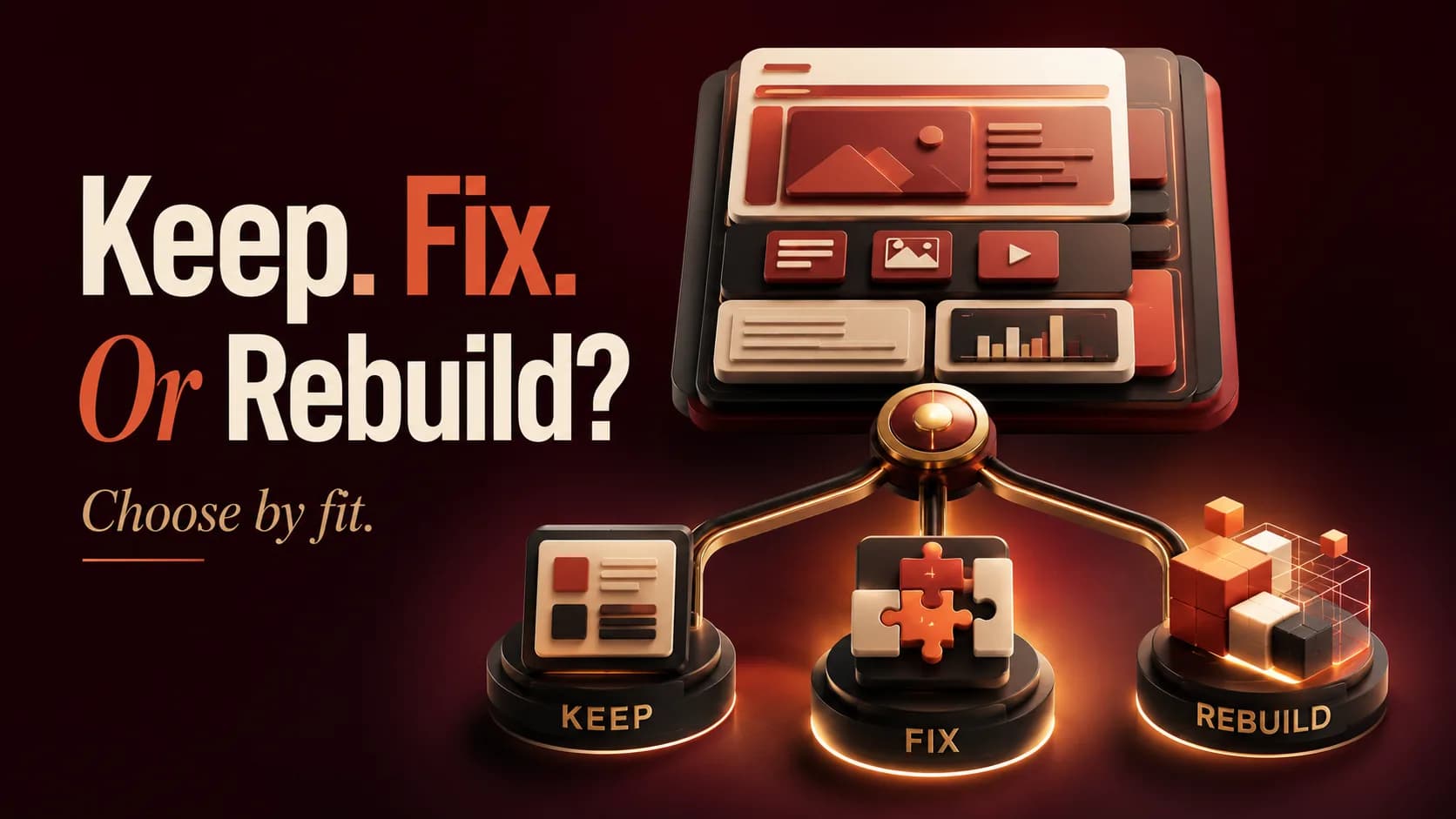
Table of contents (18)
- WordPress vs custom is the wrong first question
- When WordPress is still the responsible choice
- marketing and service pages;
- articles and editorial content;
- ordinary forms and inquiries;
- content updates that fit the CMS editing model;
- integrations that do not force the site to become a custom operations application.
- When a focused fix is enough
- Signals the website has become an operational product
- booking behavior that is central to operations rather than a simple calendar embed;
- fleet, staff or job-assignment workflows;
- a dedicated admin experience shaped around the business rather than generic CMS editing;
- multiple connected data flows that need to behave as one product;
- business rules that keep accumulating as exceptions around a plugin-oriented model.
- TiresDash as a bounded example
- Rifat Academy as a second bounded example
- A rebuild-decision checklist
- Choose the smallest responsible change
Key takeaway
A practical framework for deciding when WordPress is still the right tool, when focused fixes are enough, and when business workflows justify a custom application rebuild.
The useful question is not “Is WordPress good or bad?” It is “Does WordPress still match the job the business needs the software to do?”
That distinction matters because both extremes are expensive. Staying on a platform after the business has outgrown its operating model creates workarounds and friction. Rebuilding a perfectly adequate site as custom software creates cost and maintenance that the business did not need.
The responsible decision is usually keep, fix or rebuild - and the answer should come from the workflow, not from technology fashion.
WordPress vs custom is the wrong first question
Technology comparisons often start too low in the stack.
A better first question is: what is the website responsible for?
If it primarily publishes pages, content, services, articles and ordinary contact paths, a CMS can be exactly the right tool. If it has become the operating interface for booking rules, fleet or staff workflows, custom admin behavior and connected business data, it may no longer be “just a website.”
Once the responsibility changes, the architecture question changes with it.
When WordPress is still the responsible choice
WordPress remains a sensible choice when the core problem is content-centric.
Examples include:
- marketing and service pages;
- articles and editorial content;
- ordinary forms and inquiries;
- content updates that fit the CMS editing model;
- integrations that do not force the site to become a custom operations application.
A custom stack is not an automatic upgrade. If the current platform fits the business workflow, replacing it simply because another framework is newer is weak engineering and weak business advice.
When a focused fix is enough
A painful site also does not automatically need a rebuild.
If the problem is isolated - one broken flow, a failed integration, an authentication issue, a specific performance bottleneck, or a piece of technical debt - the smallest sensible intervention may be to repair that layer.
The key test is whether the underlying platform model still fits. If it does, a targeted fix can be more responsible than starting over.
This is the same principle I use in migration work generally: do not rewrite working responsibilities unless they are part of the real constraint.
Signals the website has become an operational product
A rebuild becomes easier to justify when the business is asking the CMS to behave like purpose-built software.
Signals can include:
- booking behavior that is central to operations rather than a simple calendar embed;
- fleet, staff or job-assignment workflows;
- a dedicated admin experience shaped around the business rather than generic CMS editing;
- multiple connected data flows that need to behave as one product;
- business rules that keep accumulating as exceptions around a plugin-oriented model.
None of these signals proves that WordPress cannot be extended. The question is whether extending it is still the clearest and most maintainable way to support the business.
TiresDash as a bounded example
TiresDash is a useful example because the requirements were not only about publishing a better-looking website.
The project context included appointment booking, B2B/B2C workflows, fleet-related functionality and supporting admin/business flows. The implementation direction moved toward a custom full-stack product experience using a Next.js/TypeScript/Express/MongoDB context. That delivery path is written up in the TiresDash WordPress-to-custom modernization case study.
That is a materially different responsibility from a normal brochure or content site. The architecture had to support operational behavior, not only pages.
What I am not claiming here is that every WordPress booking site needs the same treatment, or that the rebuild automatically produced a specific conversion, retention or speed uplift. Those outcomes require their own evidence.
The useful point is simpler: when the business-critical workflows become the product, a custom application can become the more coherent place to model them.
Rifat Academy as a second bounded example
Rifat Academy shows a different shape of the same decision. The legacy system was a WordPress/MariaDB LMS with production learning data and account behavior that still had to survive the transition. The modernization moved into a custom Next.js, Node/Express and MongoDB application, with data migration, authentication checks and production delivery treated as part of the cutover rather than cleanup afterward. That path is written up in the Rifat Academy LMS modernization case study.
Again, the claim is architectural and operational: the rebuild had to carry real system responsibilities. It is not a ranking, revenue or “zero friction” guarantee.
A rebuild-decision checklist
Before recommending a rebuild, I would ask:
1. Is the current platform still mainly managing content, or is it now responsible for core operations?
2. Are the painful parts isolated enough to fix without changing the foundation?
3. Do staff need a purpose-built admin or workflow interface?
4. Are business rules being represented clearly, or hidden across plugins and manual workarounds?
5. Would an integration solve the constraint without replacing the platform?
6. If a rebuild happens, which existing responsibilities should stay unchanged?
The last question matters. “Rebuild” should not mean “rewrite every connected system.” A good migration still defines boundaries.
Choose the smallest responsible change
There are three reasonable outcomes:
Keep the platform when it still fits.
Fix the constrained layer when the foundation still fits.
Rebuild when the business workflow has become software that the current architecture no longer represents cleanly.
The best answer is the one that solves the operating problem without adding unnecessary technical ambition.
If your current site is carrying workflows it was never meant to own, the web development and modernization services page covers how I evaluate fix vs integration vs rebuild. See also other situations where a product is already built and live. Send the context and we can decide the smallest responsible next step — start a project.

Working through something similar?
Send context from this note and I will reply with a practical next step.
Discuss this topicSee related case studyProduct engineering servicesAlready built and live?