Connect the Website to the Workflow: WordPress + GoHighLevel Without a Rebuild
First-hand note from delivery work — written against a real shipped project constraint, not a generic tutorial outline.
- Author
- Shafin Sadnan
- Publish date
- Latest update
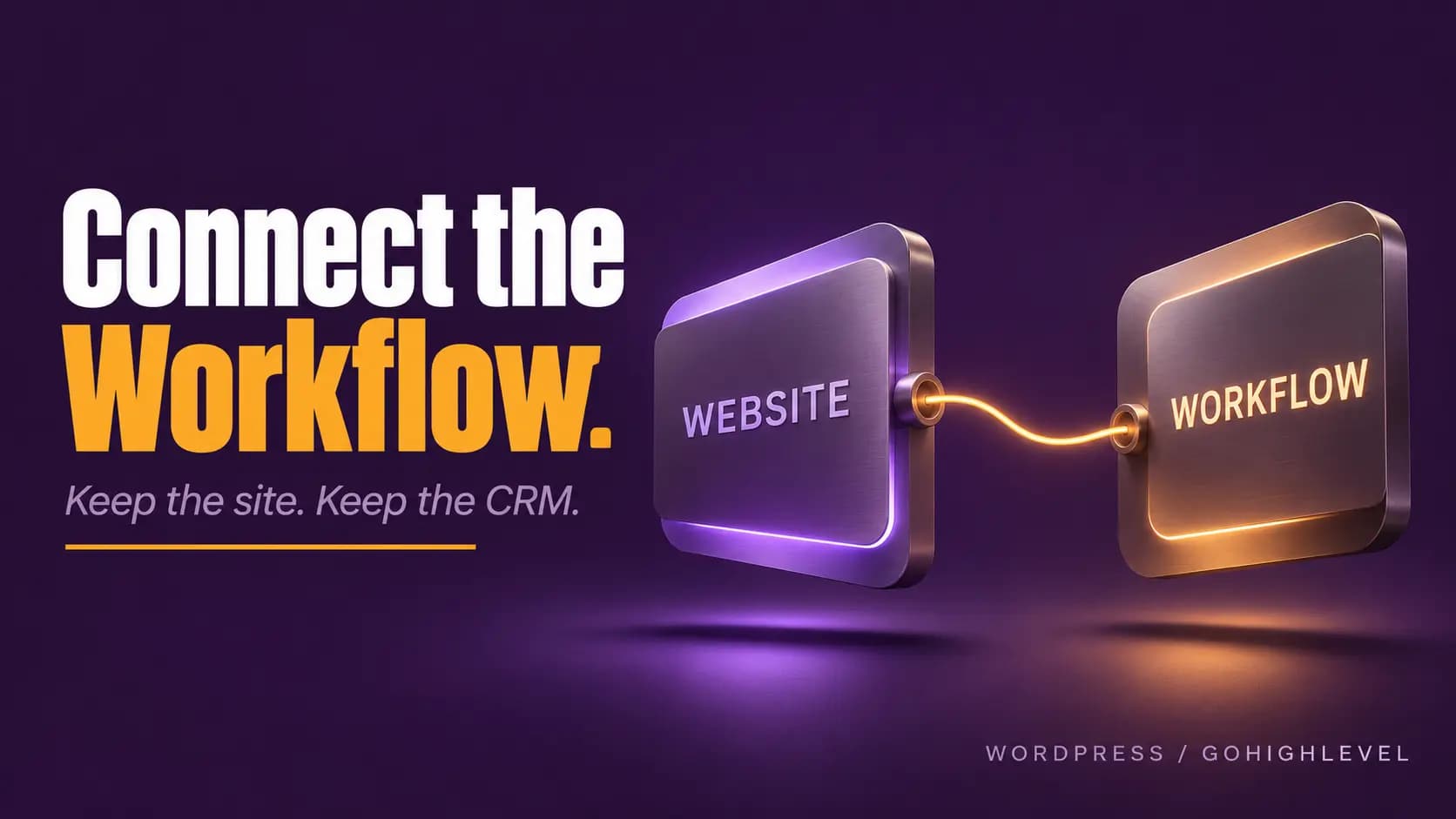
Table of contents (35)
- The decision problem
- The website may need editable service pages, landing structures and a trustworthy public experience.
- The team may already run inquiry capture and follow-up in a CRM/workflow tool.
- Rewriting both into one custom application can create a larger change surface than the constraint requires.
- When integration is enough
- Signs a rebuild may be justified instead
- Architecture and handoff model
- Trade-offs
- Integration advantages
- Smaller change surface than a full rebuild.
- Keeps editable public content where content work already happens.
- Preserves the operational system the team already uses for follow-up.
- Makes ownership clearer: website vs workflow.
- Integration costs and risks
- Two systems still need maintenance and monitoring.
- Field mapping and failure modes at the boundary must be explicit.
- If the business later needs deep custom product logic, integration may only delay a larger architectural move.
- Rebuild advantages
- One application model for workflows that have become software.
- Clearer place to encode business rules that no longer fit CMS plus plugin composition.
- Rebuild costs
- Data migration, authentication, deployment and verification become part of the job.
- Content editing and operational workflows may both need new processes.
- Implementation considerations
- implementing the public WordPress experience from the supplied design context;
- structuring responsive service and landing pages for ongoing content delivery;
- connecting website inquiry capture to the GoHighLevel-supported follow-up path;
- keeping content editable in the site for ongoing iteration;
- defining what must remain unchanged in the downstream workflow.
- Truthful project example: Ketamine Wellness NY
- implement the WordPress experience from the supplied design;
- build responsive service and landing-page structures for ongoing content delivery;
- connect website inquiry capture to GoHighLevel-supported follow-up workflows;
- keep content editable inside the site for ongoing iteration.
- A short decision checklist
Key takeaway
When the public site can stay on WordPress while inquiry and follow-up live in GoHighLevel, and why that integration boundary is often the responsible choice.
The useful question is not “Should we rebuild everything on a custom stack?”
It is: which layer is actually responsible for customer-facing content, and which layer is responsible for inquiry handling and follow-up?
Those are often different jobs. When they are, connecting them can be more responsible than replacing both.
The decision problem
A public website and an operational workflow system can fail in different ways.
- The website may need editable service pages, landing structures and a trustworthy public experience.
- The team may already run inquiry capture and follow-up in a CRM/workflow tool.
- Rewriting both into one custom application can create a larger change surface than the constraint requires.
So the decision is keep, integrate or rebuild, not “WordPress good” vs “custom app good.”
When integration is enough
Integration is often the right move when:
1. The public experience is still mainly content and conversion surfaces a CMS can own.
2. Inquiry and follow-up already have an operating home in a workflow tool the team uses.
3. The painful gap is the handoff between those layers, not the inability of either layer to do its primary job.
4. Editors still need to change pages without engineering involvement for ordinary content work.
5. Replacing the whole stack would add migration, auth, data-model and training cost without solving a clearer product constraint.
In that shape, the website stays the customer-facing layer. The workflow tool stays the operational layer. The engineering work is making the handoff reliable.
Signs a rebuild may be justified instead
A rebuild becomes easier to justify when:
1. The website is actually becoming the operations product: booking rules, staff workflows, custom admin behavior, connected business data.
2. The CMS is accumulating fragile exceptions to look like purpose-built software.
3. The team needs a single product model where content, workflow state and business rules must share one application boundary.
4. Integration would only paper over a foundation that no longer fits the operating model.
That is a different problem from “connect inquiry capture to the tool we already use.” See also the keep/fix/rebuild framing in WordPress vs. a Custom Web Application and the rebuild-shaped example in the TiresDash case study.
Architecture and handoff model
A clean integration boundary usually looks like this:
1. Public layer (WordPress): service/landing pages, editable content, form or inquiry entry points.
2. Handoff: submission events, fields and context needed downstream.
3. Workflow layer (GoHighLevel-supported path): inquiry handling and follow-up the team already operates.
The goal is not to recreate CRM behavior inside WordPress, or to force marketing pages into the CRM. The goal is a defined interface between two responsibilities.
Trade-offs
Integration advantages
- Smaller change surface than a full rebuild.
- Keeps editable public content where content work already happens.
- Preserves the operational system the team already uses for follow-up.
- Makes ownership clearer: website vs workflow.
Integration costs and risks
- Two systems still need maintenance and monitoring.
- Field mapping and failure modes at the boundary must be explicit.
- If the business later needs deep custom product logic, integration may only delay a larger architectural move.
Rebuild advantages
- One application model for workflows that have become software.
- Clearer place to encode business rules that no longer fit CMS plus plugin composition.
Rebuild costs
- Data migration, authentication, deployment and verification become part of the job.
- Content editing and operational workflows may both need new processes.
Implementation considerations
When the responsible choice is integration, the work usually includes:
- implementing the public WordPress experience from the supplied design context;
- structuring responsive service and landing pages for ongoing content delivery;
- connecting website inquiry capture to the GoHighLevel-supported follow-up path;
- keeping content editable in the site for ongoing iteration;
- defining what must remain unchanged in the downstream workflow.
What this does not require by default: turning WordPress into a full custom operations application, replacing GoHighLevel because a rebuild sounds more ambitious, or claiming ranking, lead-volume or conversion outcomes from the connection alone.
Truthful project example: Ketamine Wellness NY
For Ketamine Wellness NY, the public experience needed to support ongoing marketing and lead handling, not sit as a disconnected brochure.
The verified delivery shape was:
- implement the WordPress experience from the supplied design;
- build responsive service and landing-page structures for ongoing content delivery;
- connect website inquiry capture to GoHighLevel-supported follow-up workflows;
- keep content editable inside the site for ongoing iteration.
The existing GoHighLevel-supported operational workflow remained the downstream system. The website was connected to it rather than replacing it.
The proof is the integration and usable delivery path. This note does not claim lead volume, booking lift, ranking growth or conversion outcomes.
Full project write-up: Ketamine Wellness NY WordPress + GoHighLevel integration. Agency and partner delivery context for similar client routing: For agencies.
A short decision checklist
1. Is the painful gap the public site, the follow-up workflow, or the handoff between them?
2. Does the CMS still fit the customer-facing content job?
3. Does the workflow tool already fit inquiry and follow-up operations?
4. Would a rebuild mainly recreate two jobs that already have homes?
5. If integration ships, what failure modes at the boundary do we need to verify?
If your current constraint is a website that should stay editable while inquiry handling already lives in a workflow tool, send the current site, the downstream system and what should happen on submit — start a project. See also web development services.
Working through something similar?
Send context from this note and I will reply with a practical next step.
Discuss this topicSee related case studyProduct engineering servicesAlready built and live?Agency partner delivery